Author: Ben Springer

  • Flexing or Flexible?

    Flexing or Flexible?

    The industry secret about how some school leaders make miracles and others make miracle whip.

    It’s 9:12 AM.

    Jaxon just shared an explicit image to a classmate.

    Mrs. Hansen wants to meet ASAP about the IEP meeting last night.

    The AC is broken and half of the building is already starting to feel it.

    Congratulations! You’re a school leader! You’re in charge! What do you do?

    Insane scenarios like this are not uncommon for school leaders. Scenarios like this happen way more than parents, school board members, or the average non-educator even realizes.

    In other words, school leaders are behind the 8-ball on a daily basis. (Honestly, every educator is–it’s incredibly challenging work.)

    I wish I could tell you school leaders were all well-trained for these types of scenarios. The truth? They’re not–not even close.

    If that wasn’t concerning enough, it’s not even their fault.

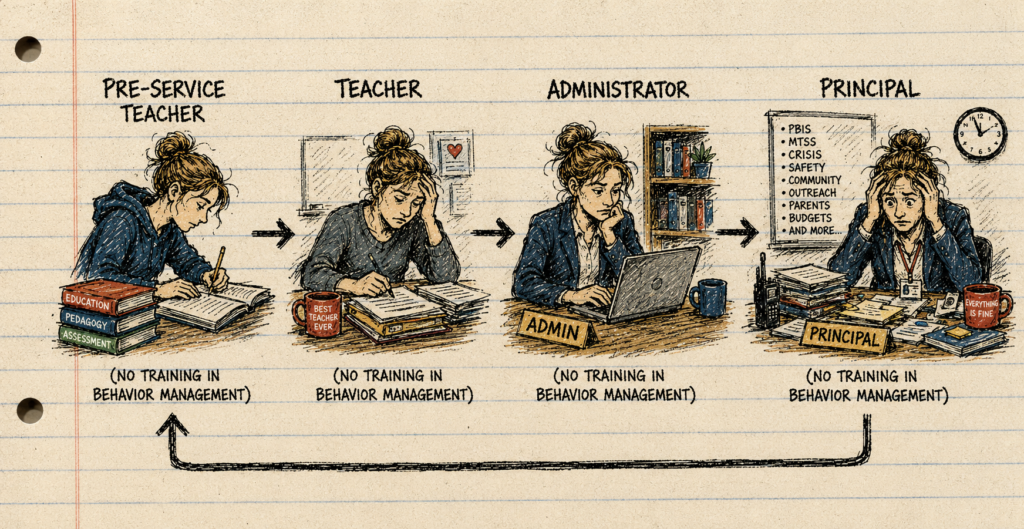
    Think about the typical principal’s pathway to leadership:

    This is an objectively bizarre professional development trajectory. And while I’ve spent a good chunk of my career trying to improve professional learning in these areas, I’m not entirely convinced “good PD” is the answer.

    Over the years, I’ve been fortunate to work alongside some wonderful school leaders. Most learned these responsibilities on the job. And the more I’ve watched them, the more I’ve wondered whether their success has less to do with preparation and more to with something else: psychological flexibility.

    It’s best to illustrate with some observations. You’ve probably watched two administrators with essentially the same preparation respond very differently to the same difficult situation.

    Admin # 1 gets increasingly rigid:

    “We already tried that.”

    “He knows the rules.”

    “There have to be consequences.”

    Admin # 2 gets curious:

    “Well, that didn’t work. What are we missing?”

    “What can we change? What can we NOT change?”

    “Who knows this kid really well?”

    The difference isn’t intelligence, commitment, or even experience. It’s flexibility.

    Psychological flexibility is the ability to stay connected to what matters while remaining willing to change what we’re doing when the situation tells us it’s not working.

    Unfortunately, when it comes to behavior and discipline, “the system” accidentally rewards the opposite. Admin are often expected to be decisive, consistent, confident, authoritative, and accountable.

    Those aren’t bad qualities. But under stress, strengths can mutate:

    decisive -> rigid

    consistent -> inflexible

    confident -> certain

    authoritative -> controlling

    Here’s where it gets wild. Think about some of the toughest kids we serve. What happens when the schedule changes? When someone says no? When their first solution doesn’t work? When the world refuses to behave the way they expected it to? They become rigid. Inflexible. Overly certain. Controlling.

    Sound familiar?

    The very quality that helps a school leader navigate a messy, unpredictable school may be one of the most important things we’re trying to teach the student sitting across from them.

    Maybe our biggest mistake is deciding that “the principal,” “the teacher,” “the kid,” or “the family” is the problem. Behavioral challenges have a funny way of making all of us more rigid.

    In schools, we spend enormous energy pursuing “mastery” and “competence.” Those things matter. But perhaps there’s another outcome worth pursuing: psychological flexibility.

    Because schools are unpredictable places filled with unpredictable humans. We aren’t going to train our way out of every difficult situation.

    Sometimes the most important thing we can learn is what to do when what we’re doing isn’t working.

  • Calm Ain’t the Goal…

    Calm Ain’t the Goal…

    Why validation–not control–is the starting point for emotional regulation.

    I’m a Capricorn. According to the cosmos, that makes me an ambitious control freak with deep rooted insecurities.

    The cosmos: 1. Ben: 0.

    When I’m brutally honest about my less-charming attributes, I really do struggle with giving up control. I’m not so much a micromanager as a “Step aside, let me do it” kind of guy.

    I’ll spare you years of my own therapy with a summary:

    Control is an illusion and life is hard.

    With that in mind, I’d like to help you avoid a few of the potholes I’ve repeatedly driven into. Specifically, I want to challenge three ideas that can feel true when we’re working with emotionally intense kids:

    Calm = Good

    Standing Your Ground = Good

    Uncomfortable Emotions = Bad

    Each of these contains just enough truth to become dangerous.

    The problem with “calm.”

    Of course, calm can be good. Calm makes classrooms easier to manage. Calm makes adults feel competent. Calm reassures us that everything is under control.

    But looking calm and being regulated are not the same thing.

    A child can be quiet because they feel safe and settled. They can also be quiet because they have shut down, given up, dissociated, masked their distress, or concluded that no one wants to hear what they are experiencing.

    Compliance can look a lot like regulation from across the room.

    That distinction matters.

    Emotional sensitivity meets the environment.

    Beginning in the 1980s, psychologist Marsha Linehan developed Dialectical Behavioral Therapy, or DBT, for people experiencing severe emotional dysregulation, chronic suicidality, and what was then considered an extraordinarily difficult-to-treat condition: borderline personality disorder.

    Linehan’s biosocial theory proposed that emotional dysregulation developed through an ongoing interaction between two forces:

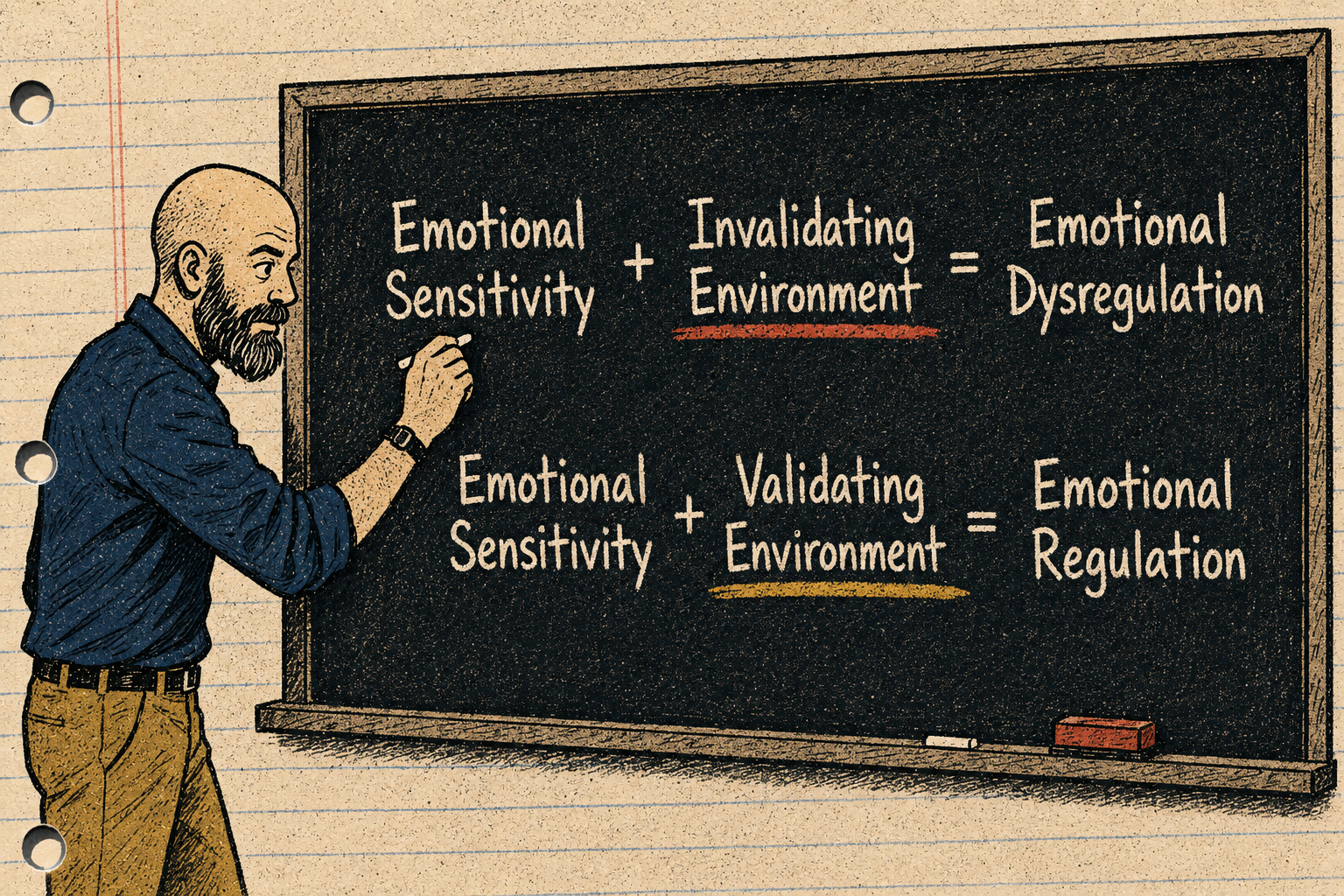
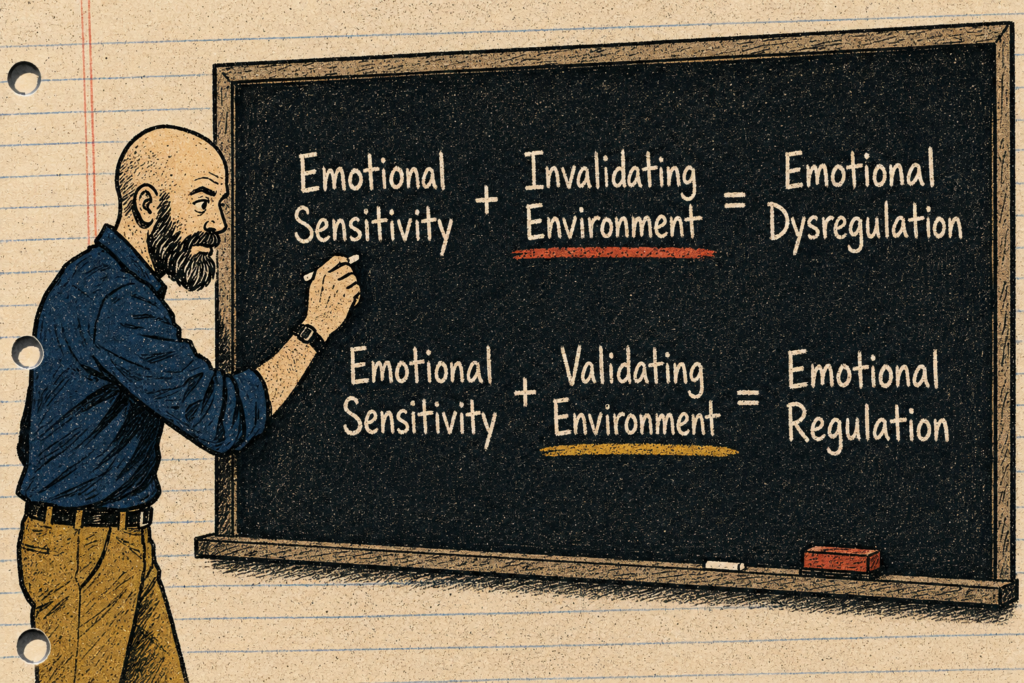
    Emotional sensitivity + an invalidating environment = greater emotional dysregulation.

    Some people experience emotions more quickly, intensely, and persistently than others. That sensitivity is not a moral failure. It is not evidence that someone is manipulative, dramatic, spoiled, or weak.

    It is a nervous system doing what that nervous system does.

    Trouble grows when emotional sensitivity repeatedly encounters an environment that communicates:

    You shouldn’t feel that way.

    This isn’t a big deal.

    Stop being so dramatic.

    Calm down.

    There’s nothing to be upset about.

    The environment does not need to be intentionally cruel to be invalidating. In fact, most people genuinely want to help. They simply want the emotion to stop–and they reach for control because control feels like the fastest route back to calm.

    Families and professionals can then fall into predictable patterns.

    They use “tough love,” meaning increasingly rigid boundaries.

    They push the person to act “normal.”

    They respond to harsh behavior with harsher behavior.

    They treat emotional intensity as a challenge to their authority.

    And then everyone becomes dysregulated.

    What validation actually means

    Validation does not mean that we agree with every interpretation, accept every demand, or excuse harmful behavior.

    It means that we recognize the person’s internal experience as real.

    A validating response might sound like:

    I can see how disappointed you are.

    That wasn’t what you expected, and the change hit you hard.

    You’re allowed to be angry. I’m going to help you be angry safely.

    Validation communicates:

    Your emotions make sense–even when your behavior needs to change.

    That is a profoundly different message from:

    Your emotions are acceptable only after you become easier for me to manage.

    When we “move and shake” with kids rather than planting our feet in judgement, they begin to trust us.

    When we accept that children may be quirky, goofy, sensitive, intense, or emotional, we make room for their humanity–and our own.

    When we permit emotions to exist without immediately correcting, minimizing, or erasing them, children become more able to experience those emotions without being overtaken by them.

    Calm is a byproduct

    Calm ain’t the goal.

    The goal is to help children feel safe enough to experience an emotion, communicate what they need, and choose what to do next.

    Calm may follow. Often, it does.

    But calm is the byproduct of validation, safety, connection, and practiced regulation skills. When adults demand calm before offering those things, we ask children to produce the outcome without providing the conditions that make it possible.

    Put another way:

    Emotional sensitive + a validating environment = a better opportunity for emotional regulation.

    Not guaranteed regulation. Not immediate regulation. Not perfect regulation.

    An opportunity.

    That is what a healthy environment provides. It’s ultimately up to the child or individual to take advantage of that opportunity.

    Validation still has boundaries

    One important qualification: validation is not tolerance.

    We can validate strong emotions while holding firm boundaries around safety.

    I believe you’re furious. I will not let you hit me.

    You have every right to be upset. You do not have the right to threaten someone.

    We can take space, ask for help, or tell me what happened. We cannot destroy the room.

    The emotion is accepted.

    The aggression is not.

    When a student behaves aggressively, adults should intervene, protect everyone involved, and follow through with reasonable, instructional consequences. Validation does not erase accountability. It makes accountability more teachable because the child no longer has to fight us for recognition of their experience.

    We do not need to choose between compassion and boundaries.

    Children need both.

    Physical and emotional violence should never be tolerated. But neither should we confuse emotional intensity with violence–or obedience with wellness.

    The goal is not to make children appear calm.

    The goal is to help them become safe enough to think, communicate, repair, and try again.

    *If this gave you something useful to think about, explore the other field notes in the magazine–or share it with some working alongside emotionally intense kids.

  • Take a Beat, Not a Beating.

    Take a Beat, Not a Beating.

    When challenging behavior makes you question everything, don’t abandon your experience. Return to it.

    When I arrived, Henry had turned over every desk in his first grade classroom and ripped every poster from the walls. He paced in the corner like a caged tiger, shouting his favorite curse words–each one filtered through the vocabulary of a six-year-old.

    He barely acknowledged I was there. When he did, it was with unmistakable contempt.

    As I took in the scene, something settled over me that surprised me: despair.

    Over the years, my teams and I had poured countless hours into supporting Henry and his family. Yet in that moment, I honestly wondered whether I had anything left to offer. I wondered if anyone else on the team felt the same way.

    What still surprises me is my response to that feeling.

    Most people assume experience protects you from helplessness. It doesn’t.

    Years of practice don’t erase frustration. If anything, difficult moments have a way of wiping away whatever confidence you thought you’d earned. When that happens, I don’t try and invent brilliant new solutions.

    I go back to the basics.

    Oddly enough, I’m grateful for that.

    Feeling overwhelmed has a way of stripping away my ego and reminding me to rebuild from the ground up–to rely on the fundamentals rather than my assumptions.

    One of the most valuable fundamentals I ever learned is something psychologists call Fundamental Attribution Bias (sometimes called the Fundamental Attribution Error).

    In plain English, it’s our tendency to explain people’s behavior by focusing on who they are while overlooking what they’re experiencing.

    Henry taught me that lesson better than any textbook ever could.

    The first time Henry lost control in school, his teacher was understandably shaken. He threw a stapler so hard it cracked the whiteboard.

    Later, I received an email.

    I’m positive he’s antisocial…maybe on the spectrum. He has zero empathy or remorse for his behavior.

    When I later spoke with the school counselor, I heard a completely different story.

    It’s heartbreaking,” she told me. “DCFS has been involved for years. He’s far behind academically. We believe he’s experienced significant trauma.

    Neither person was wrong.

    Both perspectives were true.

    The teacher naturally focused on Henry’s behavior. The counselor naturally focused on Henry’s environment.

    I made the same mistake.

    The first time I watched him explode, my internal dialogue wasn’t much different.

    Here we go again. Same apple. Same tree as his older brother.

    That’s Fundamental Attribution Bias in real time.

    Each of us was trying to make sense of the same child. Each of us gravitated toward a different explanation. The teacher saw the individual. The counselor saw the system. I blamed the family.

    None of us naturally held all the truths at once.

    And that’s the trap.

    We do this constantly–not just with students.

    We do it with parents.

    With coworkers.

    With administrators.

    With spouses.

    With strangers in traffic.

    Even with ourselves.

    Whenever we forget that people exist inside both an individual story and an environmental story, our understanding shrinks.

    The good news is that overcoming this bias doesn’t require a Ph.D.

    It starts with two simple habits.

    First, acknowledge that Fundamental Attribution Bias is real.

    Second, take a beat before taking a beating.

    Pause long enough to ask, “What part of this story am I not seeing?

    That single question won’t solve every problem.

    But it often changes the problem you’re trying to solve.