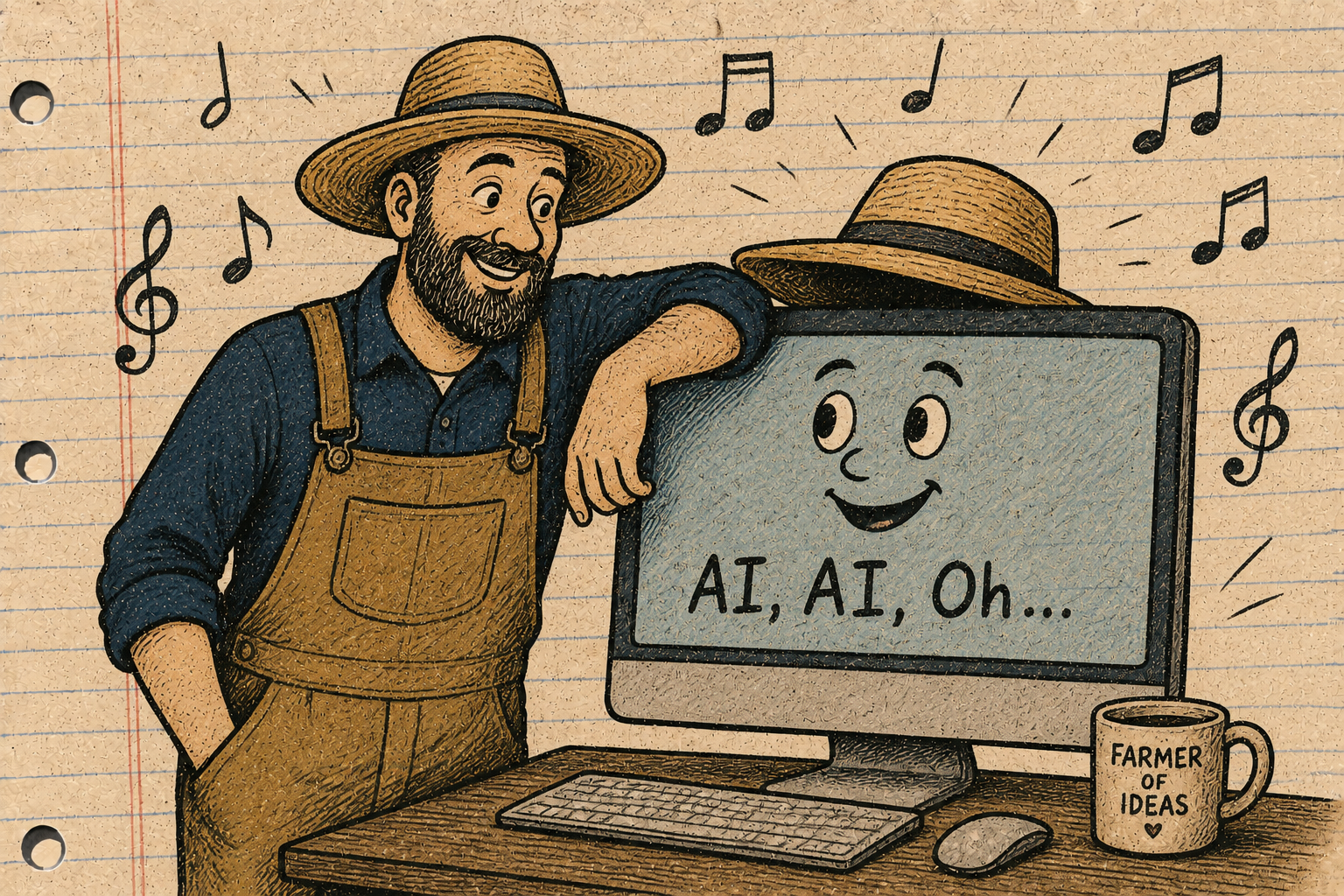
…And on that farm there was machine learning at our fingertips. With panic here, saved time there…
According to a recent CoSN (Consortium for School Networking) survey, 79% of schools districts now have AI guidelines, (up from 57% in 2025), and 64% report AI initiatives in operations.
Only 41% have initiatives involving instructional platforms for teaching and learning.
This. Is. Fascinating.
If public schools weren’t challenging enough systems to manage, they now have to incorporate this stunning new world of machine learning.
So, what exactly, should public schools be concerned with when it comes to AI?
Privacy. What happens when a teacher puts an IEP, evaluation, student writing sample, behavior report, or parent email into an AI system?
Academic Integrity. Schools initially encountered ChatGPT largely as “the machine kids can use to cheat.” That’s a terrible first introduction to a transformative technology.
Accuracy. AI can confidently produce incorrect information. Schools understandably recoil from that.
Equity. Who gets the good models? Who knows how to prompt them? Who has access at home?
Liability. If AI contributes to an instructional, disciplinary, special education, mental health, or personnel decision, who’s responsible?
Development. (Pay close attention here…) There’s a legitimate difference between an adult using AI to eliminate clerical work and a 12-year-old using it to eliminate cognitive struggle through which they’re supposed to be learning.
Finally, there’s probably the most mundane reason: Nobody knows whose job AI is.
Curriculum? Technology? Teaching and Learning? Legal? Special Education? Assessment? Cybersecurity? The Superintendent?
Yes.
This is a recipe for a ton of committees.
Well, if you find yourself on one of these committees, frame the question from “Should schools allow AI?” (because that ship has sailed) to,
“What human work should AI help us do, what human work should it never replace, and what do students need to learn about living alongside it?”
I am increasingly convinced schools will require three lanes, not one giant, “AI policy.”
Lane 1: Use it.
There are things educators spend an enormous amounts of human life doing that machines can help with. Think about how enhanced “brainstorming” sessions can become at a PLC. RAND (a nonprofit, nonpartisan organization) found that educators who were already using AI commonly used it to adapt instructional content and generate materials.
Lane 2: Protect against it.
Student personally identifiable information (PII) shouldn’t casually get fed into consumer AI systems. AI shouldn’t independently make consequential decisions about children. Teachers need to know that fluent output isn’t synonymous with accurate output. Districts need vetted systems and clear rules. Even before AI, cybersecurity and student-data privacy remain prominent concerns among district technology leaders.
Lane 3: Teach it.
Students don’t merely need rules about AI. They need AI literacy.
What’s this thing good at?
What’s it bad at?
Why does it hallucinate?
When should I trust it?
How do I verify something?
We have got to help kids understand the difference between using AI to help me think and using AI instead of thinking.
We’ve only just begun this new reality and we’re already seeing wildly different philosophies. As of today (September 2026) New York City just announced a one-year prohibition on generative AI use through the eighth grade while simultaneously introducing AI-literacy instruction for high school students and piloted vetting tools (Associated Press, 2026).
So, what does a bald, middle-aged Caucasian school psychologist think about all this? I’m so glad you asked:
Schools need to stop treating AI primarily as a technology problem. It’s human behavior problem.
We’re all dealing with a new environment that is extremely reinforcing.
It makes things easier.
It makes slow things fast.
It answer us immediately.
It removes effort.
It reduces uncertainty.
And sometimes, that’s fantastic!
But learning frequently requires precisely the things AI can help us avoid: effort, uncertainty, frustration, revision, waiting, trying something that doesn’t work, and thinking again.
If I’m being brutally honest, rearing children and educating children is almost the opposite experience of using AI. Working with children is not fast. Kids don’t respond to us immediately. Kids require an a lot effort. The world our kids inhabit is an uncertain place.
I’ve actually never blamed technology for all the problems kids and families face.
I’ve blamed convenience.
We are easily more addicted to the convenience technology provides us than the actual technology. If we’re not deliberate about understanding child development, I’m afraid we’ll consider kids as inconveniences instead of wonders. What an awful future that would be.
It’s not about AI. It’s about us.