Why validation–not control–is the starting point for emotional regulation.
I’m a Capricorn. According to the cosmos, that makes me an ambitious control freak with deep rooted insecurities.
The cosmos: 1. Ben: 0.
When I’m brutally honest about my less-charming attributes, I really do struggle with giving up control. I’m not so much a micromanager as a “Step aside, let me do it” kind of guy.
I’ll spare you years of my own therapy with a summary:
Control is an illusion and life is hard.
With that in mind, I’d like to help you avoid a few of the potholes I’ve repeatedly driven into. Specifically, I want to challenge three ideas that can feel true when we’re working with emotionally intense kids:
Calm = Good
Standing Your Ground = Good
Uncomfortable Emotions = Bad
Each of these contains just enough truth to become dangerous.
The problem with “calm.”
Of course, calm can be good. Calm makes classrooms easier to manage. Calm makes adults feel competent. Calm reassures us that everything is under control.
But looking calm and being regulated are not the same thing.
A child can be quiet because they feel safe and settled. They can also be quiet because they have shut down, given up, dissociated, masked their distress, or concluded that no one wants to hear what they are experiencing.
Compliance can look a lot like regulation from across the room.
That distinction matters.
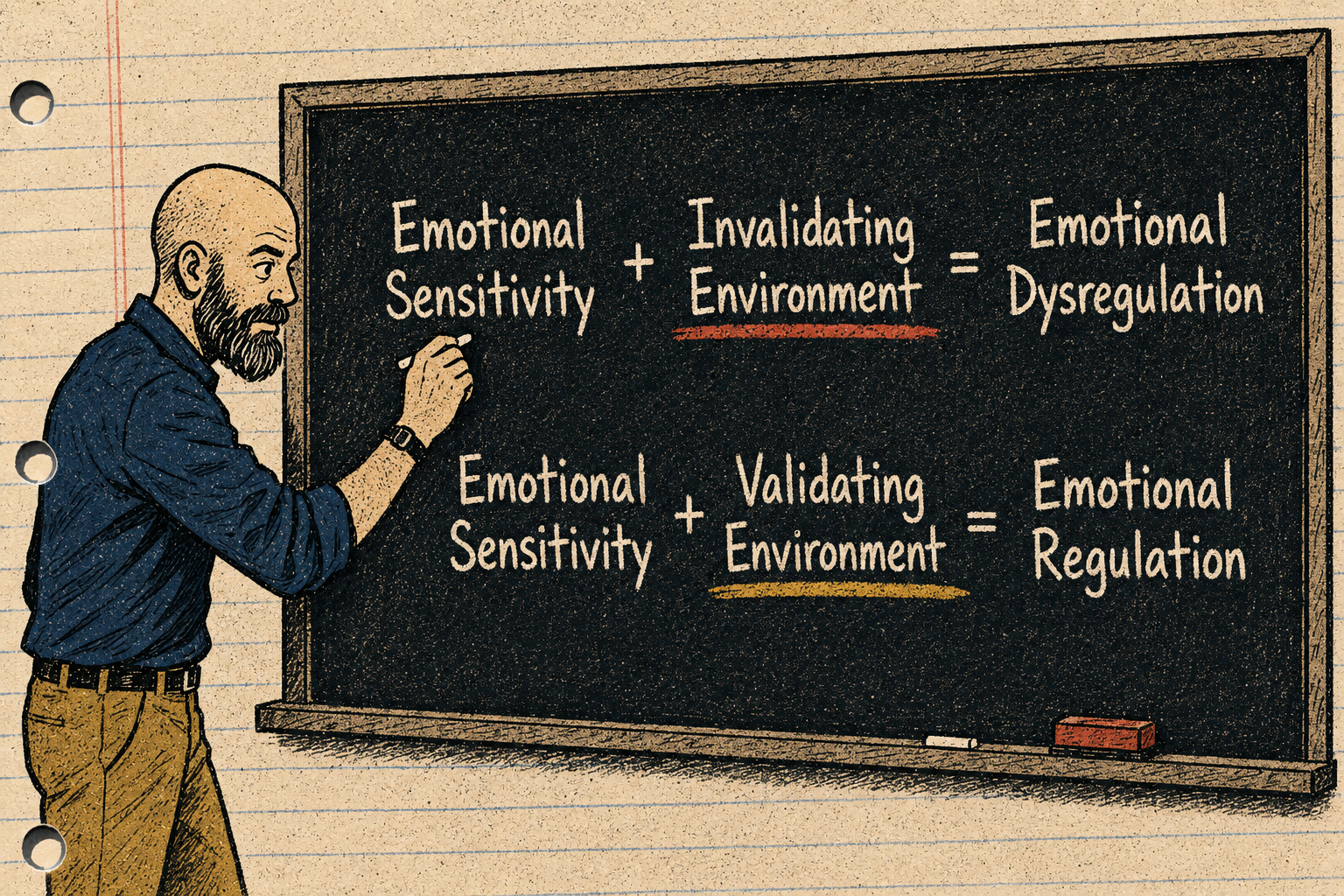
Emotional sensitivity meets the environment.
Beginning in the 1980s, psychologist Marsha Linehan developed Dialectical Behavioral Therapy, or DBT, for people experiencing severe emotional dysregulation, chronic suicidality, and what was then considered an extraordinarily difficult-to-treat condition: borderline personality disorder.
Linehan’s biosocial theory proposed that emotional dysregulation developed through an ongoing interaction between two forces:
Emotional sensitivity + an invalidating environment = greater emotional dysregulation.
Some people experience emotions more quickly, intensely, and persistently than others. That sensitivity is not a moral failure. It is not evidence that someone is manipulative, dramatic, spoiled, or weak.
It is a nervous system doing what that nervous system does.
Trouble grows when emotional sensitivity repeatedly encounters an environment that communicates:
You shouldn’t feel that way.
This isn’t a big deal.
Stop being so dramatic.
Calm down.
There’s nothing to be upset about.
The environment does not need to be intentionally cruel to be invalidating. In fact, most people genuinely want to help. They simply want the emotion to stop–and they reach for control because control feels like the fastest route back to calm.
Families and professionals can then fall into predictable patterns.
They use “tough love,” meaning increasingly rigid boundaries.
They push the person to act “normal.”
They respond to harsh behavior with harsher behavior.
They treat emotional intensity as a challenge to their authority.
And then everyone becomes dysregulated.
What validation actually means
Validation does not mean that we agree with every interpretation, accept every demand, or excuse harmful behavior.
It means that we recognize the person’s internal experience as real.
A validating response might sound like:
“I can see how disappointed you are.“
“That wasn’t what you expected, and the change hit you hard.”
“You’re allowed to be angry. I’m going to help you be angry safely.”
Validation communicates:
Your emotions make sense–even when your behavior needs to change.
That is a profoundly different message from:
Your emotions are acceptable only after you become easier for me to manage.
When we “move and shake” with kids rather than planting our feet in judgement, they begin to trust us.
When we accept that children may be quirky, goofy, sensitive, intense, or emotional, we make room for their humanity–and our own.
When we permit emotions to exist without immediately correcting, minimizing, or erasing them, children become more able to experience those emotions without being overtaken by them.
Calm is a byproduct
Calm ain’t the goal.
The goal is to help children feel safe enough to experience an emotion, communicate what they need, and choose what to do next.
Calm may follow. Often, it does.
But calm is the byproduct of validation, safety, connection, and practiced regulation skills. When adults demand calm before offering those things, we ask children to produce the outcome without providing the conditions that make it possible.
Put another way:
Emotional sensitive + a validating environment = a better opportunity for emotional regulation.
Not guaranteed regulation. Not immediate regulation. Not perfect regulation.
An opportunity.
That is what a healthy environment provides. It’s ultimately up to the child or individual to take advantage of that opportunity.
Validation still has boundaries
One important qualification: validation is not tolerance.
We can validate strong emotions while holding firm boundaries around safety.
“I believe you’re furious. I will not let you hit me.“
“You have every right to be upset. You do not have the right to threaten someone.”
“We can take space, ask for help, or tell me what happened. We cannot destroy the room.”
The emotion is accepted.
The aggression is not.
When a student behaves aggressively, adults should intervene, protect everyone involved, and follow through with reasonable, instructional consequences. Validation does not erase accountability. It makes accountability more teachable because the child no longer has to fight us for recognition of their experience.
We do not need to choose between compassion and boundaries.
Children need both.
Physical and emotional violence should never be tolerated. But neither should we confuse emotional intensity with violence–or obedience with wellness.
The goal is not to make children appear calm.
The goal is to help them become safe enough to think, communicate, repair, and try again.
*If this gave you something useful to think about, explore the other field notes in the magazine–or share it with some working alongside emotionally intense kids.