When challenging behavior makes you question everything, don’t abandon your experience. Return to it.
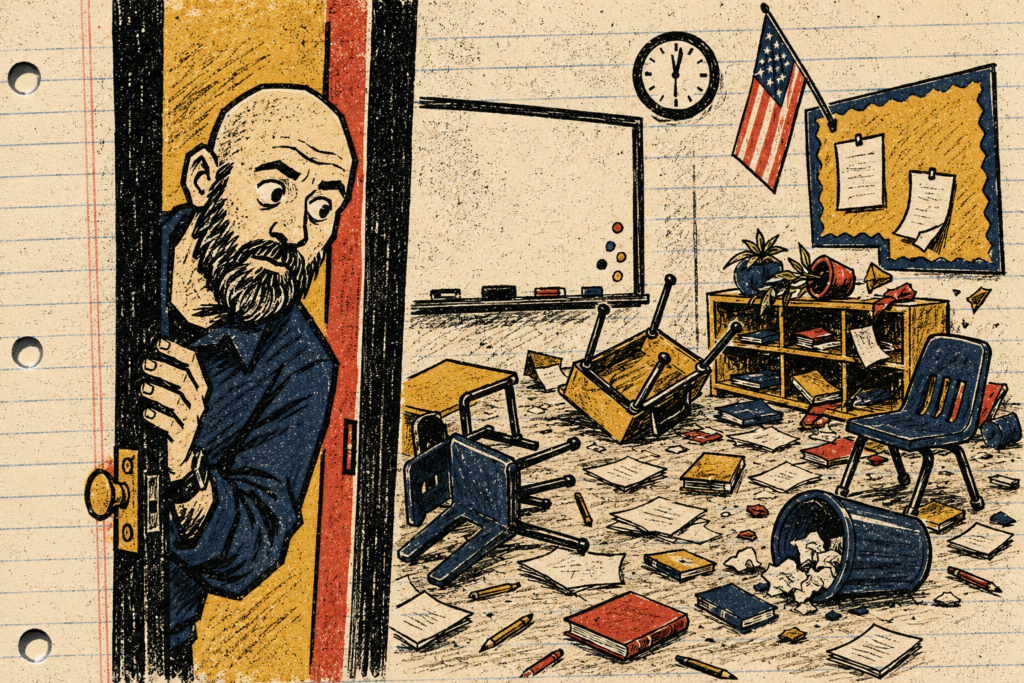
When I arrived, Henry had turned over every desk in his first grade classroom and ripped every poster from the walls. He paced in the corner like a caged tiger, shouting his favorite curse words–each one filtered through the vocabulary of a six-year-old.
He barely acknowledged I was there. When he did, it was with unmistakable contempt.
As I took in the scene, something settled over me that surprised me: despair.
Over the years, my teams and I had poured countless hours into supporting Henry and his family. Yet in that moment, I honestly wondered whether I had anything left to offer. I wondered if anyone else on the team felt the same way.
What still surprises me is my response to that feeling.
Most people assume experience protects you from helplessness. It doesn’t.
Years of practice don’t erase frustration. If anything, difficult moments have a way of wiping away whatever confidence you thought you’d earned. When that happens, I don’t try and invent brilliant new solutions.
I go back to the basics.
Oddly enough, I’m grateful for that.
Feeling overwhelmed has a way of stripping away my ego and reminding me to rebuild from the ground up–to rely on the fundamentals rather than my assumptions.
One of the most valuable fundamentals I ever learned is something psychologists call Fundamental Attribution Bias (sometimes called the Fundamental Attribution Error).
In plain English, it’s our tendency to explain people’s behavior by focusing on who they are while overlooking what they’re experiencing.
Henry taught me that lesson better than any textbook ever could.
The first time Henry lost control in school, his teacher was understandably shaken. He threw a stapler so hard it cracked the whiteboard.
Later, I received an email.
“I’m positive he’s antisocial…maybe on the spectrum. He has zero empathy or remorse for his behavior.“
When I later spoke with the school counselor, I heard a completely different story.
“It’s heartbreaking,” she told me. “DCFS has been involved for years. He’s far behind academically. We believe he’s experienced significant trauma.“
Neither person was wrong.
Both perspectives were true.
The teacher naturally focused on Henry’s behavior. The counselor naturally focused on Henry’s environment.
I made the same mistake.
The first time I watched him explode, my internal dialogue wasn’t much different.
“Here we go again. Same apple. Same tree as his older brother.“
That’s Fundamental Attribution Bias in real time.
Each of us was trying to make sense of the same child. Each of us gravitated toward a different explanation. The teacher saw the individual. The counselor saw the system. I blamed the family.
None of us naturally held all the truths at once.
And that’s the trap.
We do this constantly–not just with students.
We do it with parents.
With coworkers.
With administrators.
With spouses.
With strangers in traffic.
Even with ourselves.
Whenever we forget that people exist inside both an individual story and an environmental story, our understanding shrinks.
The good news is that overcoming this bias doesn’t require a Ph.D.
It starts with two simple habits.
First, acknowledge that Fundamental Attribution Bias is real.
Second, take a beat before taking a beating.
Pause long enough to ask, “What part of this story am I not seeing?“
That single question won’t solve every problem.
But it often changes the problem you’re trying to solve.