The industry secret about how some school leaders make miracles and others make miracle whip.

It’s 9:12 AM.
Jaxon just shared an explicit image to a classmate.
Mrs. Hansen wants to meet ASAP about the IEP meeting last night.
The AC is broken and half of the building is already starting to feel it.
Congratulations! You’re a school leader! You’re in charge! What do you do?
Insane scenarios like this are not uncommon for school leaders. Scenarios like this happen way more than parents, school board members, or the average non-educator even realizes.
In other words, school leaders are behind the 8-ball on a daily basis. (Honestly, every educator is–it’s incredibly challenging work.)
I wish I could tell you school leaders were all well-trained for these types of scenarios. The truth? They’re not–not even close.
If that wasn’t concerning enough, it’s not even their fault.
Think about the typical principal’s pathway to leadership:
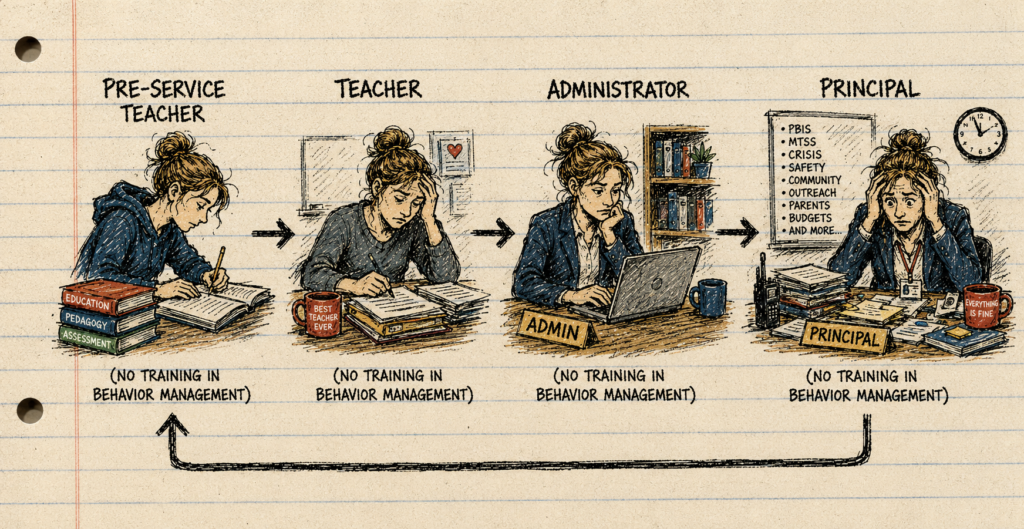
This is an objectively bizarre professional development trajectory. And while I’ve spent a good chunk of my career trying to improve professional learning in these areas, I’m not entirely convinced “good PD” is the answer.
Over the years, I’ve been fortunate to work alongside some wonderful school leaders. Most learned these responsibilities on the job. And the more I’ve watched them, the more I’ve wondered whether their success has less to do with preparation and more to with something else: psychological flexibility.
It’s best to illustrate with some observations. You’ve probably watched two administrators with essentially the same preparation respond very differently to the same difficult situation.
Admin # 1 gets increasingly rigid:
“We already tried that.”
“He knows the rules.”
“There have to be consequences.”
Admin # 2 gets curious:
“Well, that didn’t work. What are we missing?”
“What can we change? What can we NOT change?”
“Who knows this kid really well?”
The difference isn’t intelligence, commitment, or even experience. It’s flexibility.
Psychological flexibility is the ability to stay connected to what matters while remaining willing to change what we’re doing when the situation tells us it’s not working.
Unfortunately, when it comes to behavior and discipline, “the system” accidentally rewards the opposite. Admin are often expected to be decisive, consistent, confident, authoritative, and accountable.
Those aren’t bad qualities. But under stress, strengths can mutate:
decisive -> rigid
consistent -> inflexible
confident -> certain
authoritative -> controlling
Here’s where it gets wild. Think about some of the toughest kids we serve. What happens when the schedule changes? When someone says no? When their first solution doesn’t work? When the world refuses to behave the way they expected it to? They become rigid. Inflexible. Overly certain. Controlling.
Sound familiar?
The very quality that helps a school leader navigate a messy, unpredictable school may be one of the most important things we’re trying to teach the student sitting across from them.
Maybe our biggest mistake is deciding that “the principal,” “the teacher,” “the kid,” or “the family” is the problem. Behavioral challenges have a funny way of making all of us more rigid.
In schools, we spend enormous energy pursuing “mastery” and “competence.” Those things matter. But perhaps there’s another outcome worth pursuing: psychological flexibility.
Because schools are unpredictable places filled with unpredictable humans. We aren’t going to train our way out of every difficult situation.
Sometimes the most important thing we can learn is what to do when what we’re doing isn’t working.